The Execution Optimization Framework™

Execution Optimization Framework

Three Core Components

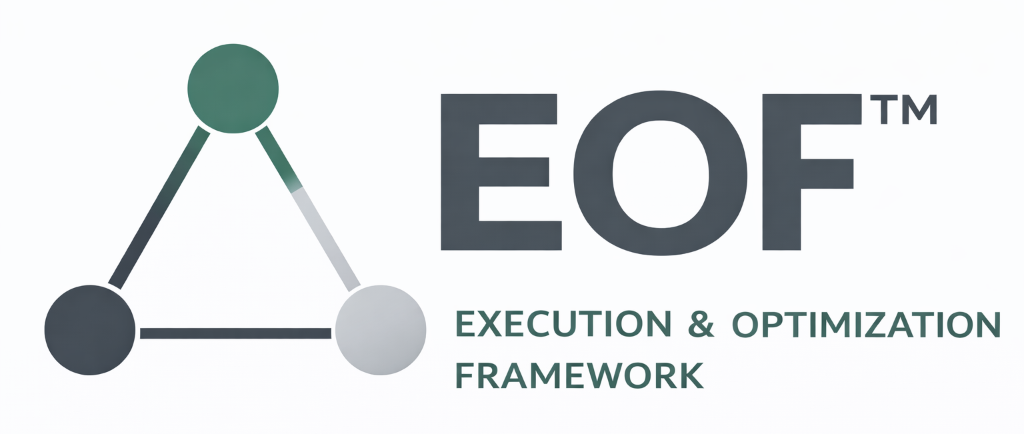
The Execution Optimization Framework™ (EOF™) integrates three interdependent elements to deliver sustained performance.

1️⃣ Project Governance

Structured oversight and accountability ensuring initiatives maintain clear objectives, disciplined decision-making, risk management, and measurable progress tracking.

Key Principles

  • Clear roles, responsibilities, and decision authority
  • Defined escalation pathways for risks and issues
  • Executive visibility through structured reporting
  • Alignment to strategic objectives and priorities
  • Disciplined change control and scope management

2️⃣ Process Optimization

Disciplined operational improvement that eliminates waste, aligns workflows to strategy, and embeds efficiency into day-to-day execution.

Key Principles

  • Data-driven analysis of current-state performance
  • Root cause identification and waste elimination
  • Future-state design aligned to strategic goals
  • Standardized workflows and operating procedures
  • Performance measurement and continuous improvement

3️⃣ Sustained Performance

The intersection of governance and optimization—where structured oversight ensures process improvements are implemented, monitored, and sustained beyond the initial initiative.

Key Principles

  • Integration of governance frameworks with operational workflows
  • Performance monitoring and control mechanisms
  • Internal capability development and knowledge transfer
  • Continuous improvement culture and accountability
  • Long-term outcome tracking and course correction

Sustained Performance is achieved when project governance provides accountability and process optimization delivers operational discipline. Neither is sufficient alone—the EOF™ ensures they function as an integrated system.

Four-Phase Implementation Model

The Execution Optimization Framework™ (EOF™) is applied through a structured four-phase approach that ensures methodological rigor from assessment through sustainment.

Each phase builds sequential discipline while maintaining measurable accountability.

01 — Assess

Evaluate current-state capabilities, identify performance gaps, and define strategic objectives.

Key Activities

  • Current-state governance and process assessment
  • Stakeholder interviews and data analysis
  • Performance gap identification
  • Root cause analysis of constraints or inefficiencies
  • Strategic objective alignment and success criteria definition

Typical Outputs

  • Assessment summary and findings report
  • Current-state process maps and governance documentation
  • Performance gap analysis
  • Initiative charter and defined objectives

02 — Architect

Design governance structures, future-state processes, and performance frameworks tailored to organizational context.

Key Activities

  • Governance framework and decision structure design
  • Future-state process design and workflow optimization
  • KPI framework and performance dashboard design
  • Change management and stakeholder engagement planning
  • Implementation roadmap and phased strategy

Typical Outputs

  • Governance framework documentation
  • Future-state process maps and SOPs
  • KPI framework and dashboard prototypes
  • Implementation roadmap and project plan

03 — Execute

Activate governance frameworks, deploy process improvements, and establish performance monitoring systems.

Key Activities

  • Governance structure activation
  • Process implementation and workflow deployment
  • Performance tracking system activation
  • Training delivery and capability development
  • Progress monitoring, issue resolution, and course correction

Typical Outputs

  • Active governance cadence and reporting structure
  • Operational future-state processes
  • Performance dashboards and KPI tracking
  • Trained teams with documented knowledge transfer

04 — Sustain

Embed accountability structures to ensure improvements are maintained and performance is continuously monitored.

Key Activities

  • Performance monitoring and control plan implementation
  • Continuous improvement framework activation
  • Internal capability validation and coaching
  • Governance structure handoff to internal ownership
  • Long-term outcome tracking and periodic review

Typical Outputs

  • Sustainment plan and monitoring procedures
  • Continuous improvement playbook
  • Internal team capability validation
  • Lessons learned and best practices documentation

When to Apply OEF™

The OEF™ is designed for growing small-to-mid-market organizations facing execution friction — typically companies in these situations:

  • Scaling Chaos: Revenue is growing, but operations feel increasingly chaotic and dependent on heroics.
  • Performance Plateau: Effort is high, but results have flatlined — there's no clear path to the next level.
  • Strategic Misalignment: The leadership team has a strategy, but execution feels disconnected, reactive, or inconsistent.
  • Operational Inefficiency: Processes are slow, duplicative, or bottlenecked — work gets done, but not efficiently.
  • Weak Accountability: It's unclear who owns what, how performance is measured, or what happens when things fall behind.
  • Capability Gap: Teams lack the skills, discipline, or habits to execute consistently without external oversight.

If any of these describe your organization, the OEF™ provides the structured approach to eliminate friction, optimize operations, and build sustainable execution capacity.

OEF™ Framework Visualization

OEF™ Framework Diagram

Ready to Apply the OEF™?

Let's discuss how the Optimization & Execution Framework™ can transform your organization's execution capacity.